27/03/2026

A Visit to Audio Note UK – It is late in the afternoon when my colleague Guido Boerboom and I drive onto the industrial estate of Hove — a small town just above Brighton in West Sussex, on England’s southern coast. It’s a place that feels more like a cluster of artisan workshops than the home of one of the world’s most idiosyncratic high-end audio brands.
>> Klik hier voor de Nederlandse tekst op Hifi.nl <<
A factory visit to Audio Note UK is like stepping into a TARDIS or an enchanted wizard’s tent — from the outside modest and unassuming, but inside revealing a seemingly endless audio Valhalla.
Behind a plain façade with a small “Audio Note” sign lies a completely different world: a company that has been defying the prevailing laws of the audio industry for decades, charting its own uncompromising course. There are no marketing hype boards, no digital dashboards, no gleaming robot arms. Instead, the air smells of solder, resin, and warm metal — the kind of handcrafted atmosphere you’d associate with a luthier rather than an electronics manufacturer.
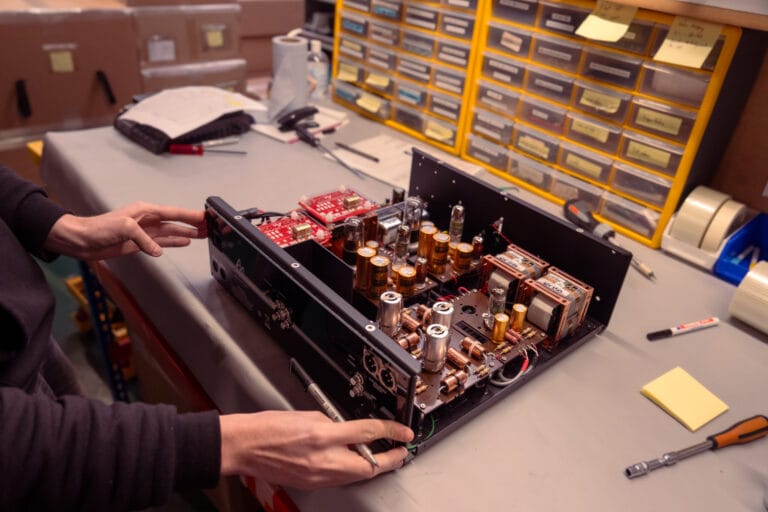
A “vintage” Audio Note unit in the service department
Over the next two days, we get the chance to see where and how this almost mythical equipment is created — and, more importantly, why it is done the way it is.
Audio Note UK was founded in the 1990s by Peter Qvortrup, a man who seems as much a thinker and archivist as a manufacturer. His philosophy is simple yet radical: music over measurements, experience over theory.
While much of the industry continues to digitize and optimize, Audio Note builds tube equipment with minimal circuit complexity. Key components such as transformers and capacitors are manufactured in-house. Their belief: the less a circuit does, the less it interferes with music’s emotional core — and the more clearly you hear the contrasts between recordings.
This philosophy is not a marketing slogan; it’s tangible in every room of the building. In what looks like organized chaos, staff assemble components surrounded by small boxes of parts, building amplifiers and DACs as if they were precision instruments from another era. Nothing is rushed. Nothing is left to chance.
Every product must fit into the company’s “Level System”, a hierarchy that helps customers build a musically coherent system — from entry level to the most exotic top tier.
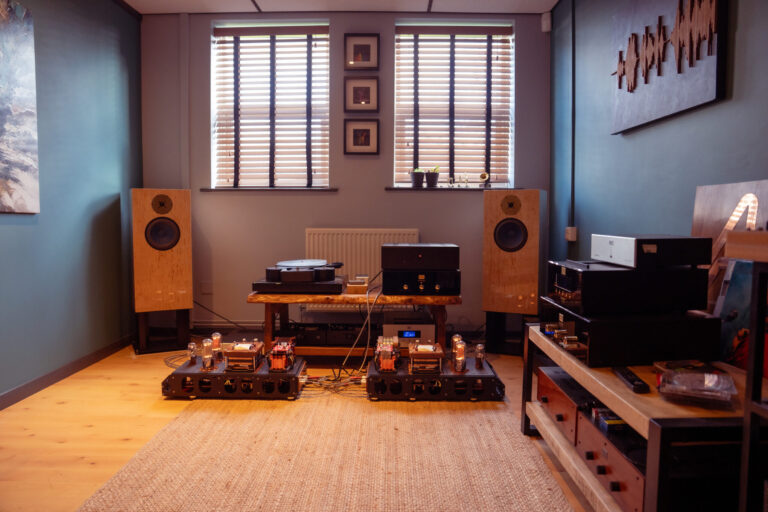
Listening room at the factory
The contrast with the modern audio world could hardly be greater. But perhaps that’s exactly why Audio Note UK still enjoys an almost cult-like status. The brand doesn’t promise perfect graphs; it promises something much harder to quantify: a listening experience that feels like a breath of fresh air — free of obstacles and technical barriers, a direct injection of pure musicality.
Peter Qvortrup’s son, Daniel, welcomes us at the factory together with James Taylor, a recent hire tasked with “marketing” Audio Note — something the company itself feels slightly awkward about. Their products tend to sell themselves, and there is little desire for aggressive expansion.
Daniel, along with his sister Emily — the company’s CEO — represents the next generation that will carry forward the legacy their father built. Emily runs daily operations in and outside the factory, while Daniel acts as brand ambassador and guardian of the company’s purist philosophy.
We sit down in the canteen with a good cup of coffee. Pointing at a Siemens fully automatic machine that’s at least 20 years old, Daniel laughs:
“Must have made tens of thousands of cups by now!”
It’s a theme that returns throughout our visit: true quality is timeless.
Proof of that stands parked behind the building — and in several nearby warehouses — in the form of an impressive fleet of Mercedes E-Class W124 AMG models.
“These cars are the best ever made — the sweet spot of engineering before electronics started breaking everything,” Peter explains later that evening as he drives us at remarkable speed and ease along pitch-dark country roads toward our hotel, while philosophizing almost nonstop about the state of the world and global economics.

Audio Note’s fleet of Mercedes W124s
Peter Qvortrup, originally Danish, studied political science and economics at the University of Copenhagen. He worked for shipping giant Maersk and opened the hi-fi store Audio Consult in 1978, which still operates today. In 1984 he founded Audio Innovations, which he sold in 1989. After collaborating with Hiroyasu Kondo, he split the UK branch from the Japanese Audio Note Kondo organization in 1998, forming Audio Note UK. The two companies differ significantly in both philosophy and sonic character.
After a wonderful sushi dinner the previous evening and a visit to “Alphabet,” a trendy hi-fi café equipped with Audio Note gear and excellent cocktails, Peter picks us up and brings us back to the factory.
I’ll admit I had prejudices about the seemingly chaotic working style of this manufacturer. Those impressions turned out to be very, very far removed from the extreme quality and attention devoted to every tiny detail of their products.
From input socket to speaker terminal, only UK-made components are used — many produced entirely in-house. All parts are auditioned at the material level to determine the best choice for a balanced final design.
We begin in the service department, equipped with extremely costly Audio Precision measurement gear and, according to Daniel, “the best tube tester in the world.”
“People think we don’t measure,” he says. “But we absolutely do. Measurements are a development tool — not a goal in themselves.”
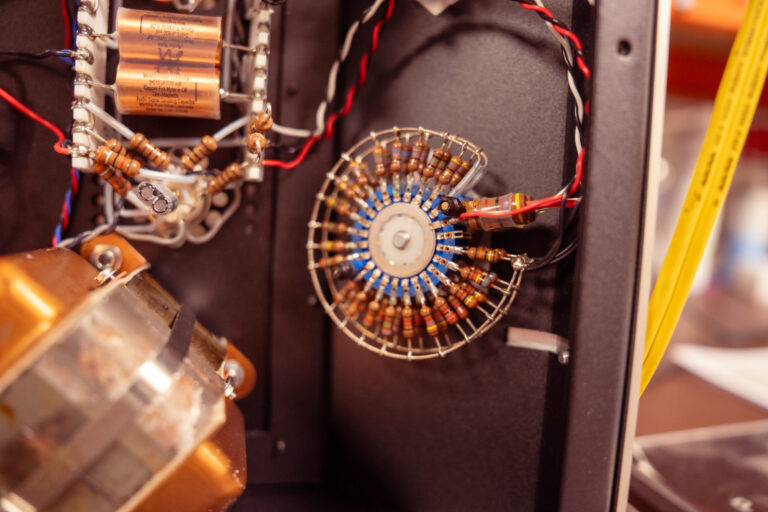
Older stepped volume control
We continue to the assembly of the beautiful stepped attenuator volume controls. The mechanical base is now milled in-house from a solid block of aluminum using an advanced CNC machine.
“The hard part,” Daniel explains while showing us the interior, “was preventing audible clicks when adjusting the volume. That took a long time to figure out.”
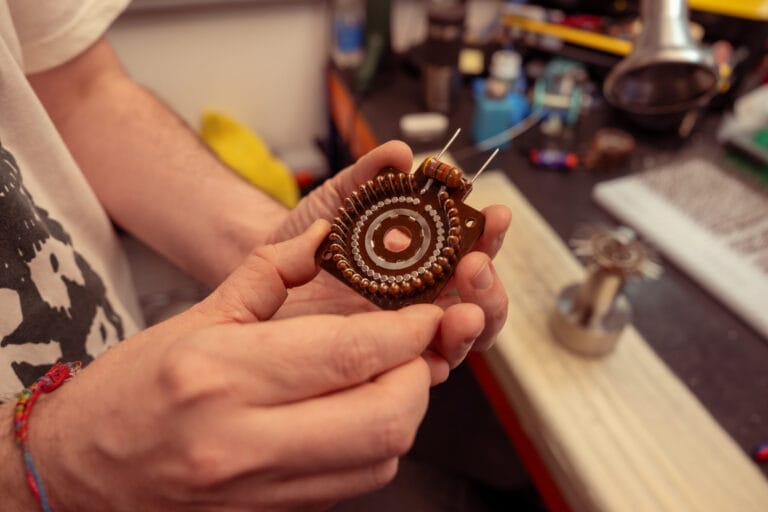
Interior of the new stepped attenuator
Next we visit the transformer winding department, where coils of every size are made — from smaller than a dice cube to massive output transformers. Because transformers are crucial for natural and dynamic sound reproduction, they are wound using the purest copper or silver on extremely precise machines. The tighter and more uniform the windings, the less the transformer vibrates.
At another warehouse, the transformers are fully submerged in resin. Using vacuum and high temperatures, all oxygen is removed with an extraordinarily expensive machine, making the transformers extremely quiet. The core material remains a closely guarded secret, but together with winding precision it is absolutely critical.
Right next to the transformer department, capacitors are manufactured using heavy-duty machines acquired when the original supplier ceased production. Watching these capacitors take shape slowly and meticulously in five layers is fascinating. Pure handwork.
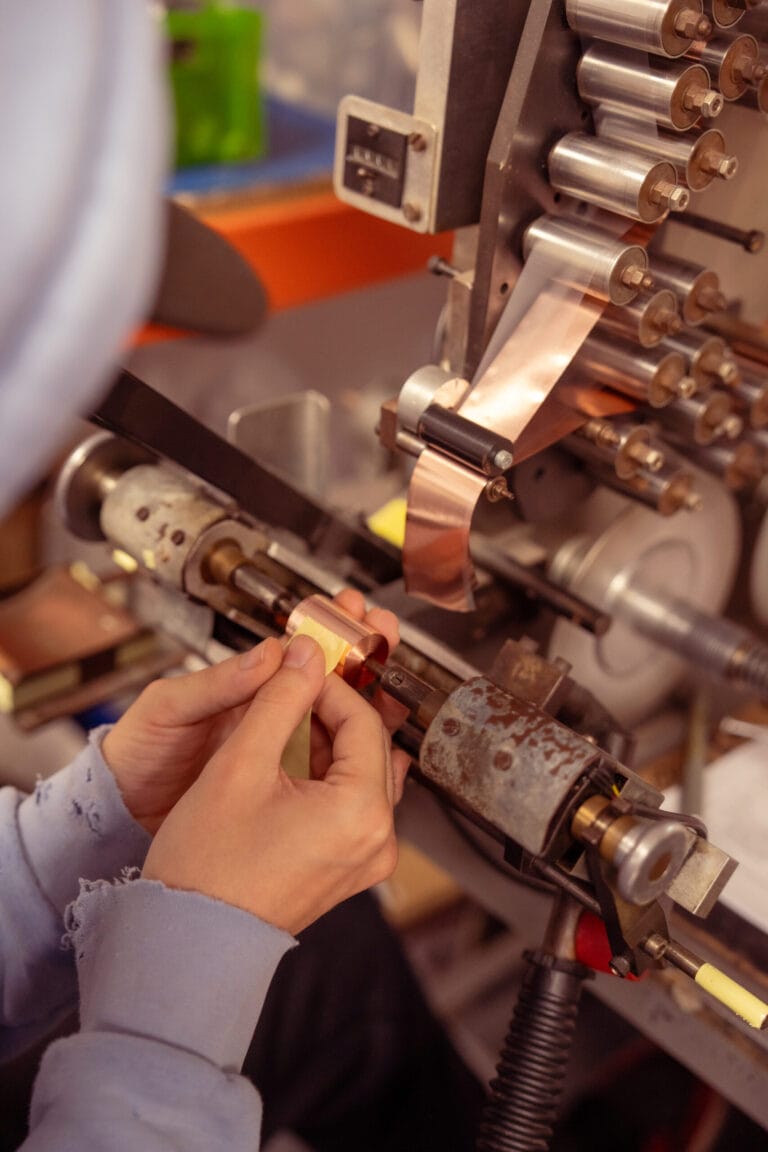
Hand-wound capacitors
Perhaps the most impressive part of the tour is the parts inventory. Shelf after shelf holds resistors, connectors, tubes — a lot of tubes — capacitors, and more. It’s dizzying, yet all perfectly organized with barcodes and numbering.
Especially notable is the silver stock, stored behind lock and key in a secured cage. With silver prices constantly rising, it’s hardly an unnecessary precaution.
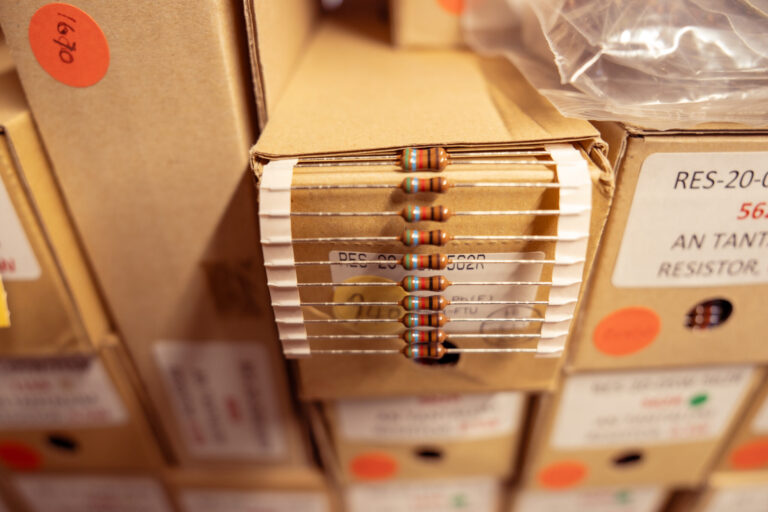
Tantalum resistors in ample supply
Audio Note UK’s key designers are Darko Greguras and Andy Grove, both at the absolute top of their field. Andy has been involved since the early days, particularly in amplifier development, including the company’s most iconic product: the OTO integrated amplifier. Since the early 1990s it has changed only in details — Audio Note rarely introduces new products. But when they do, they are invariably unique and radically different.
A few years ago, they released a special limited version of their AN-E loudspeaker using field-coil drivers instead of permanent magnets in both tweeter and woofer. Years in development, these drivers solve many problems inherent to permanent magnets. The result is a shocking improvement in dynamics, timing, and tonal color.
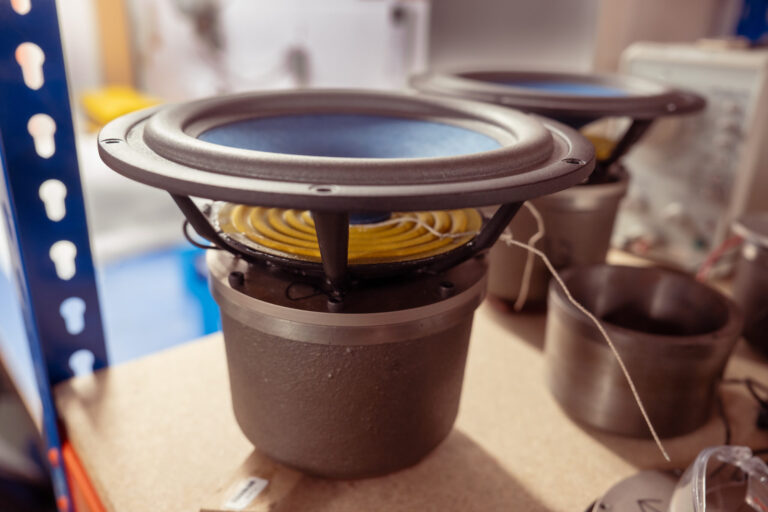
Field-coil woofer
Another radical product is Audio Note’s version of a ladder DAC, refined by Darko over many years. It uses extremely precise resistors mounted in a unique way to ensure thermal stability and long-term reliability. This DAC delivers such realism that you forget you’re listening to digital audio.
Because this level of quality demands an equally capable CD transport — Audio Note still considers CD superior to streaming — they redesigned that as well. The newest model uses an idler wheel instead of gears to drive the mechanism. Radical indeed.
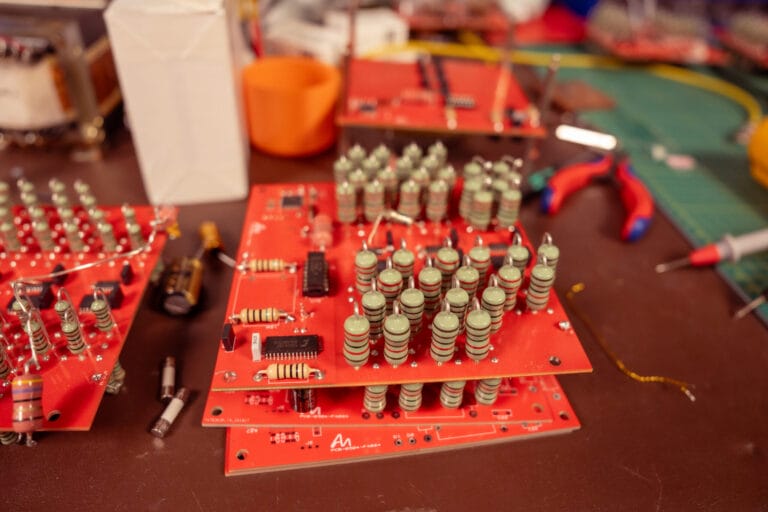
Various prototype DAC boards for the new ladder DAC
After the extensive factory tour, we’re invited to a listening session in the almost legendary listening room at Peter Qvortrup’s home in Brighton. Many famous visitors have sat on the listening couch in this room, completely filled with records.
“I really need to organize these one day — I can’t find anything anymore!” Peter laughs. He owns more than 100,000 albums across virtually every genre imaginable.

Daniel (right) and Peter (left) Qvortrup in Peter’s listening room
The system here includes (sometimes experimental) versions of all the brand’s top products.
The sound? I didn’t really hear it. At this extraordinary level, it was always the music itself in all its facets that completely commanded attention — whether it was ear-splitting techno or 1960s blues from R.L. Burnside.
Though, admittedly, the exceptional cognac and whisky Peter kept pouring may also have played a role.
When we finally prepared to head out for an Indian dinner in town, I realized just how emotionally affected I was — my eyes were filled with tears. What an incredibly intense experience.
Never before have I been so impressed by a visit to an audio manufacturer. The level of care devoted to literally every aspect of every component in every product borders on obsession.
The joy and craftsmanship of the production team, combined with Peter and Daniel’s passion and love for music, made this visit an unforgettable experience.
Everything Audio Note creates breathes a desire to make music — where time falls away and only music remains.
The only way to truly understand it is to listen to an Audio Note system.
Or better yet — own one. And never look back.